Perturb-And-Solve: Efficient Learned-Operator Conditioning for Latent Diffusion Inverse Problems
In short
A small learned network degrades the diffusion model's prediction directly in latent space. PASEO conditions on it with no back-propagation through the diffusion network.
Fast latent solvers handle only a fixed set of degradations. General ones are slow, because every step differentiates through the denoiser. PASEO keeps the generality and drops that cost: one solver covers super-resolution, deblurring, inpainting, JPEG restoration and nonlinear blur.
The idea / five equations
01 / The gradient problem

xt sits inside the denoiser: every step back-propagates through it.
02 / The way out: a proxy

Noise prediction at a proxy state, as in DING: it becomes a constant.

03 / A learned operator is not Gaussian

The operator is a neural network, so the posterior has no closed form.
04 / Linearize the operator, repeatedly

Only Jacobian-vector products are needed, never the Jacobian itself.
05 / Perturb, then solve


Kj Gaussian posterior gain · cj linearization offset
Noise on the prior mean and the measurement, then one linear solve: a posterior sample for the price of the mean.
Reconstructions / drag the dividers
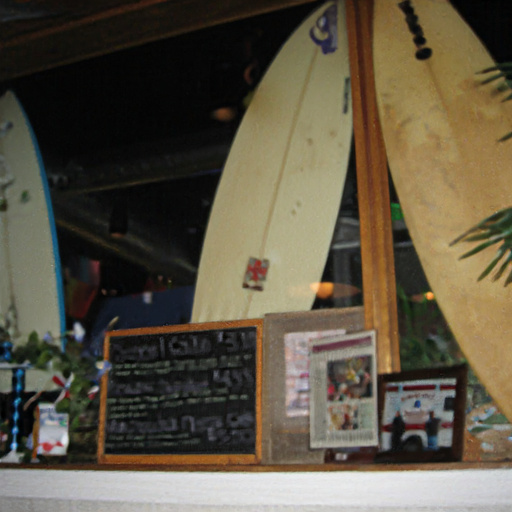
 MeasurementPASEO
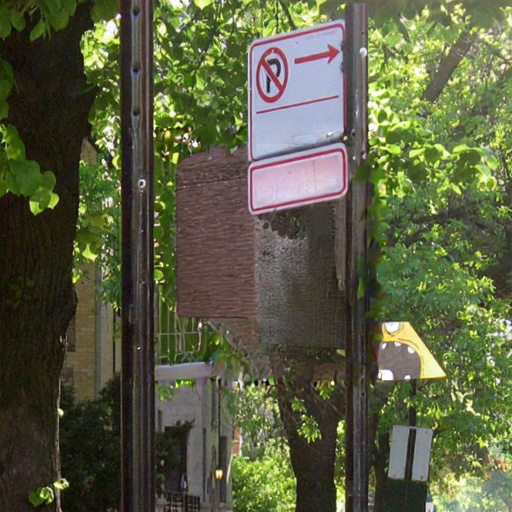
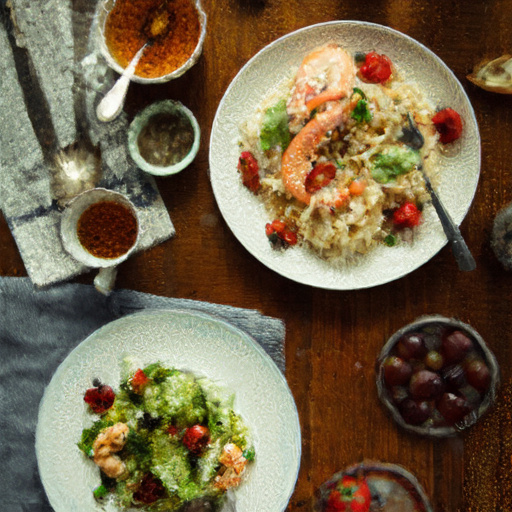
 MeasurementPASEO
COCO images, SD3.5-medium. SILO's step size was tuned on these three images. Images are shown as produced, saved as high-quality JPEG for the web.
Results / FFHQ, SD3.5-medium
| LPIPS ↓, seconds ↓ | PASEO | SILO |
|---|---|---|
| SR ×4 | 0.18210.6 s | 0.30320 s |
| SR ×8 | 0.3308.8 s | 0.50120 s |
| Gaussian blur | 0.2008.6 s | 0.39920 s |
| Inpainting | 0.11813.6 s | 0.43020 s |
| JPEG | 0.35013.9 s | 0.50320 s |
| Nonlinear blur | 0.1309.2 s | 0.35926.4 s |
| Peak memory | 16.8 GB | 21.2 GB |
SILO is our SD3.5 extension, tuned per task, at 79 denoiser evaluations; PASEO uses 53. Nonlinear blur memory: 17.2 vs 39.9 GB.
SILO is the fastest baseline on five of the six tasks. ReSample, PSLD, GML-DPS, LDPS, DiffPIR and NDTM take roughly 3× to 30× as long as PASEO. Full tables are in the paper.
Citation
@article{shtanchaev2026perturb,
  title   = {Perturb-and-Solve: Efficient Learned-Operator Conditioning
             for Latent Diffusion Inverse Problems},
  author  = {Shtanchaev, Abduragim and Asadulaev, Arip and Labazanova, Luiza
             and Alimbayev, Aidar and Salta, Karim and Moulines, Eric},
  journal = {arXiv preprint arXiv:2609.33171},
  year    = {2026}
}
Presented at the NeurIPS 2026 STODY and BeNTo workshops, Sydney